Introductory price — today only

Digital PDF book, sent by email. Nothing ships in the mail.

The step-by-step guide to seeing what comes first when every answer looks right

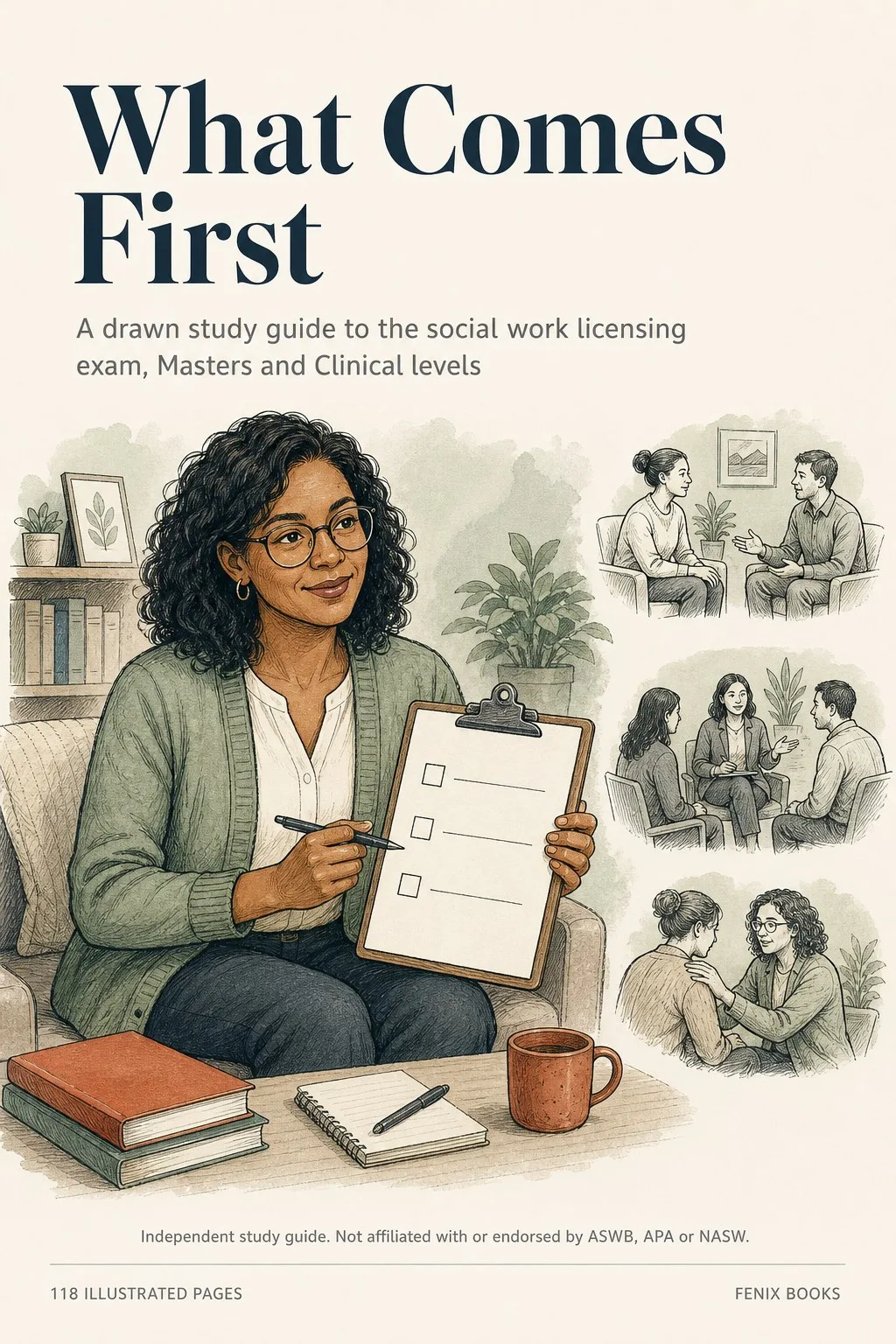
You already know the theory. See the order of decision drawn, one decision per page, without another list of rules to memorize. Independent study guide. Not affiliated with or endorsed by ASWB, APA or NASW.

Get What Comes First ➔

One payment · Sent to your inbox as a PDF · 30 days to try it

118illustrated topic pages
10 parts8 of topics, 2 of practice questions
2 booksincluded for practice and review
PDFby email, printable

Take a look inside the book

Read it on your phone and zoom in where you need to, or print it for the kitchen table.

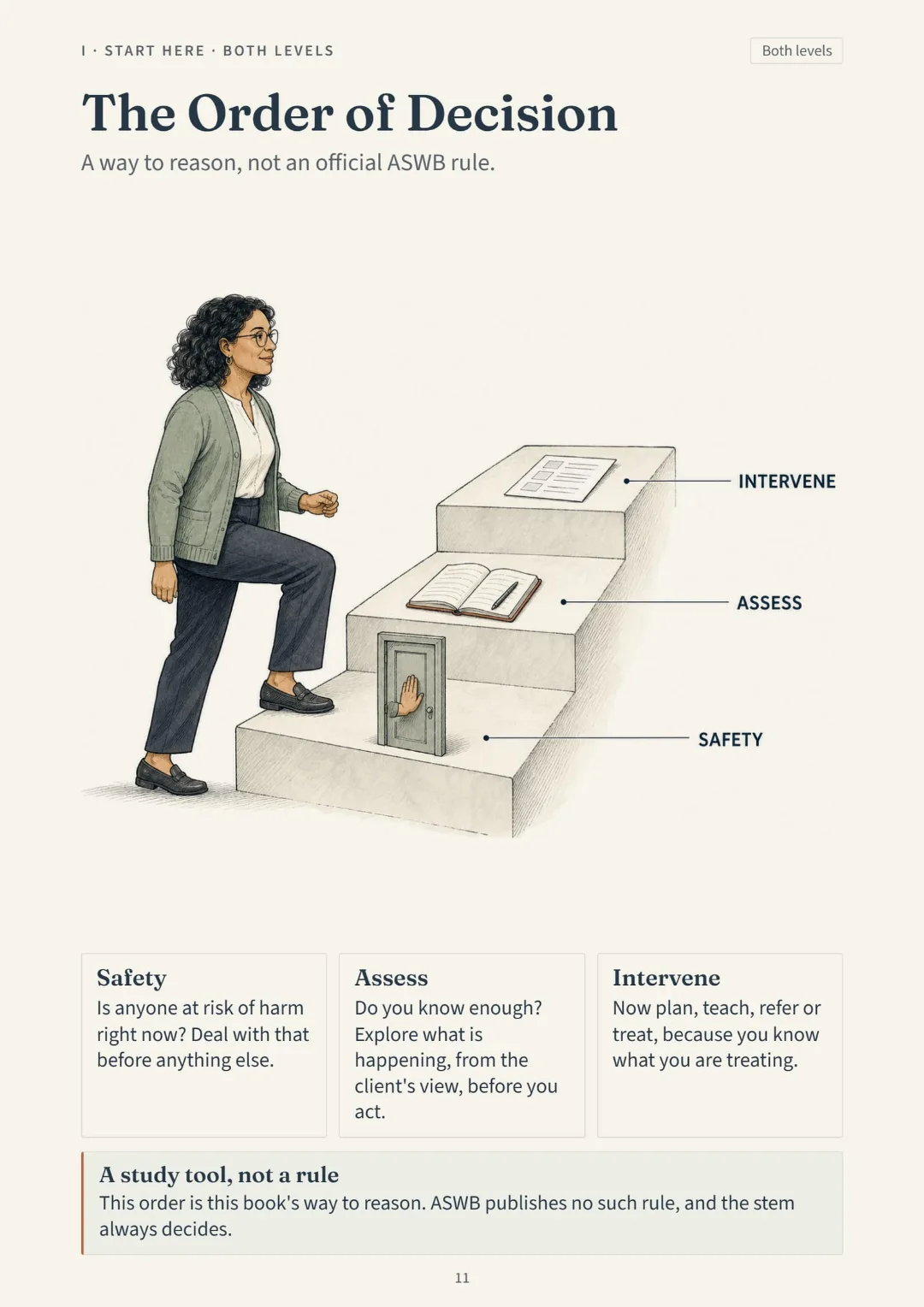
A way to reason, not an official ASWB rule. When several options look right, ask: safety, assess, then intervene.
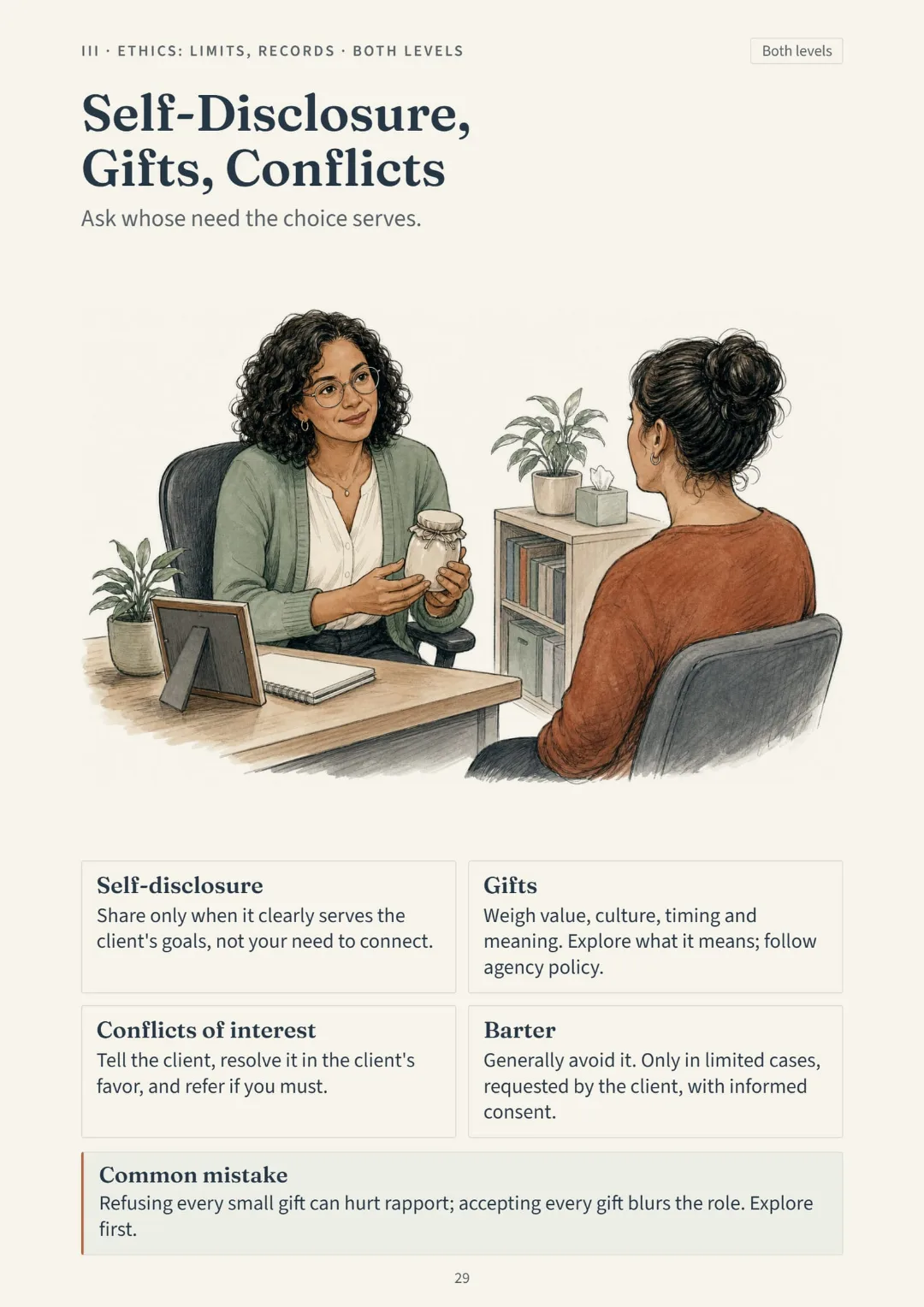
Ask whose need the choice serves. Before you share or accept, ask whose need it serves.
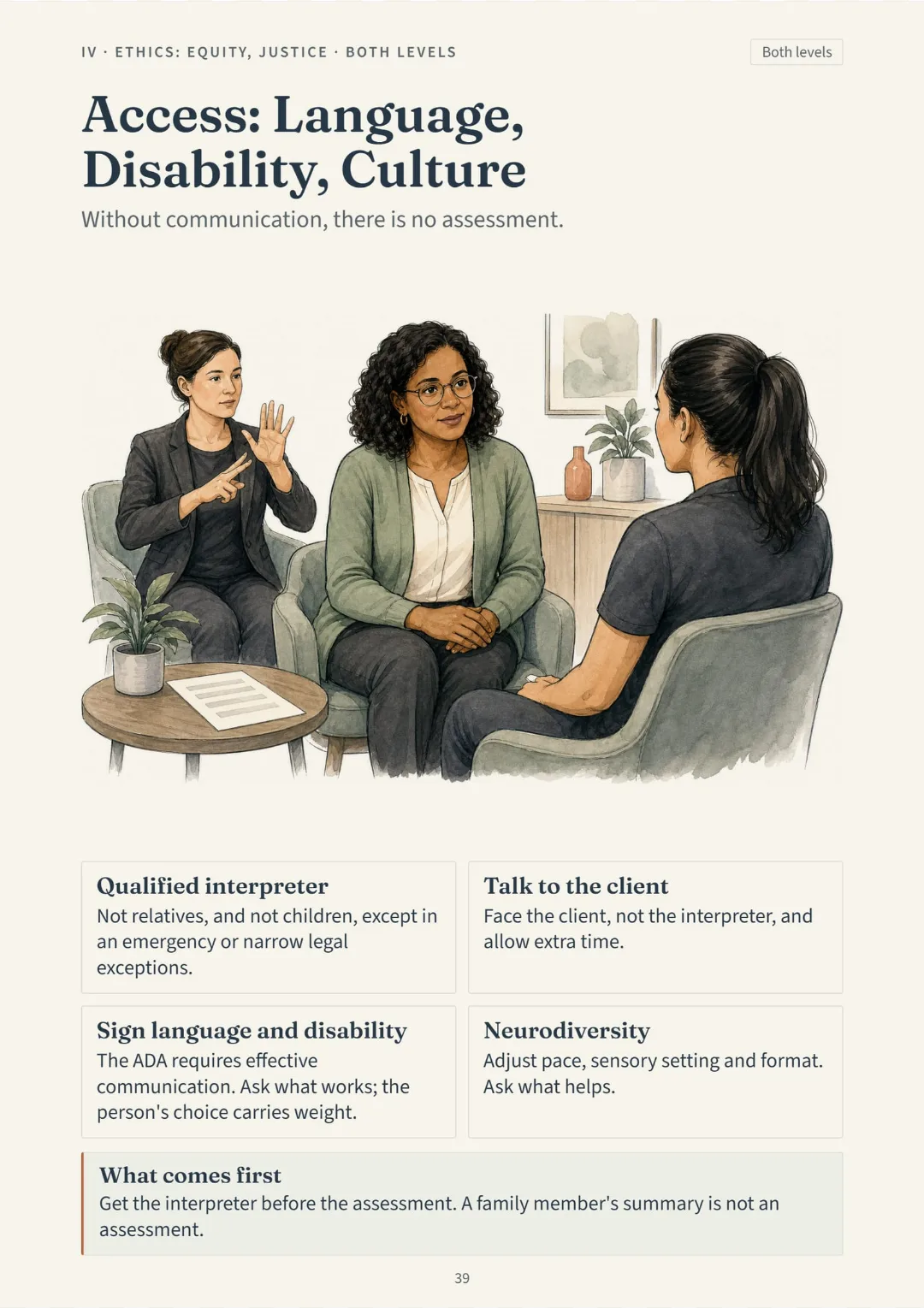
Without communication, there is no assessment. Arrange real communication before you try to assess anyone.
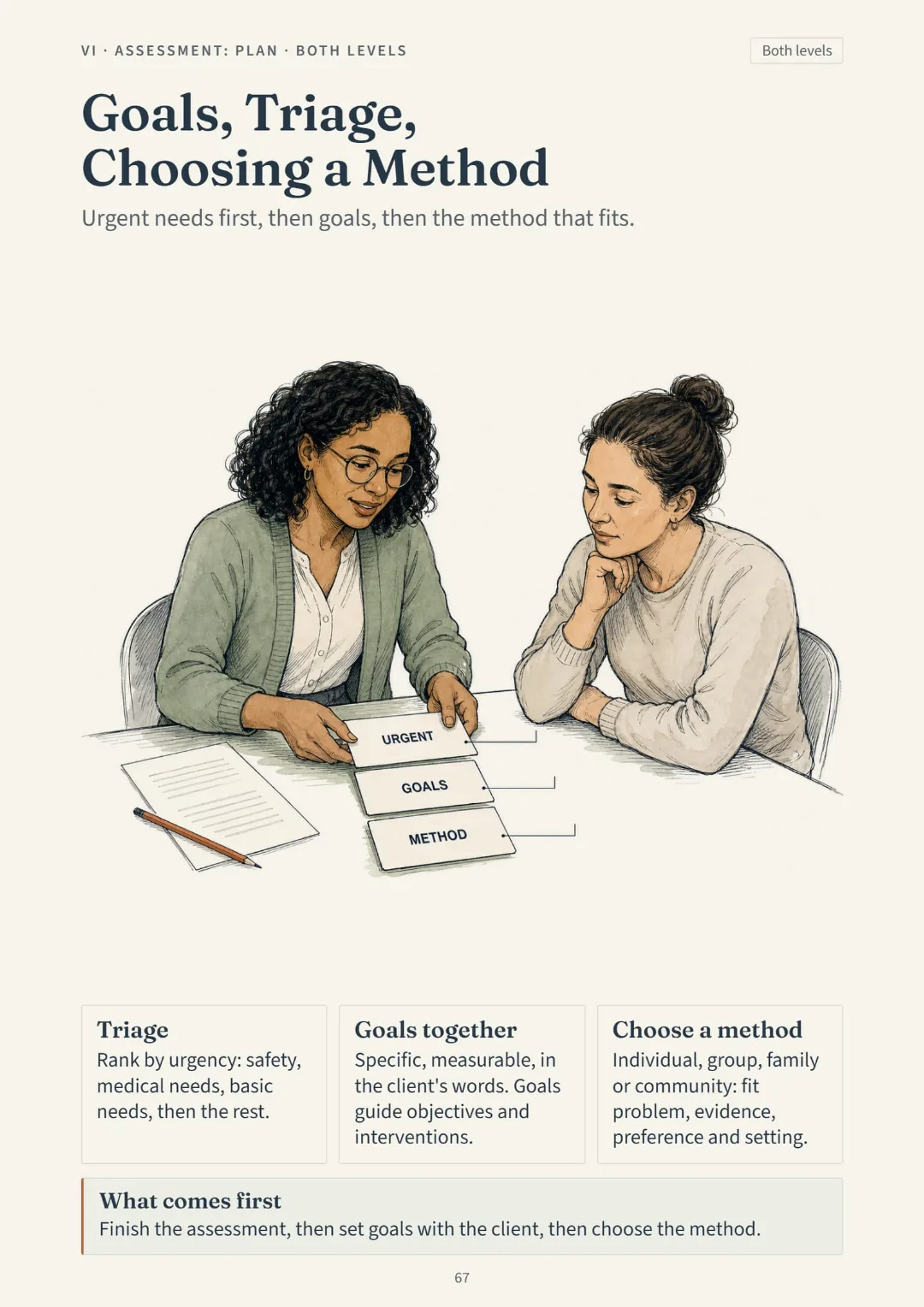
Urgent needs first, then goals, then the method that fits. Rank by urgency, set goals together, then choose a method.
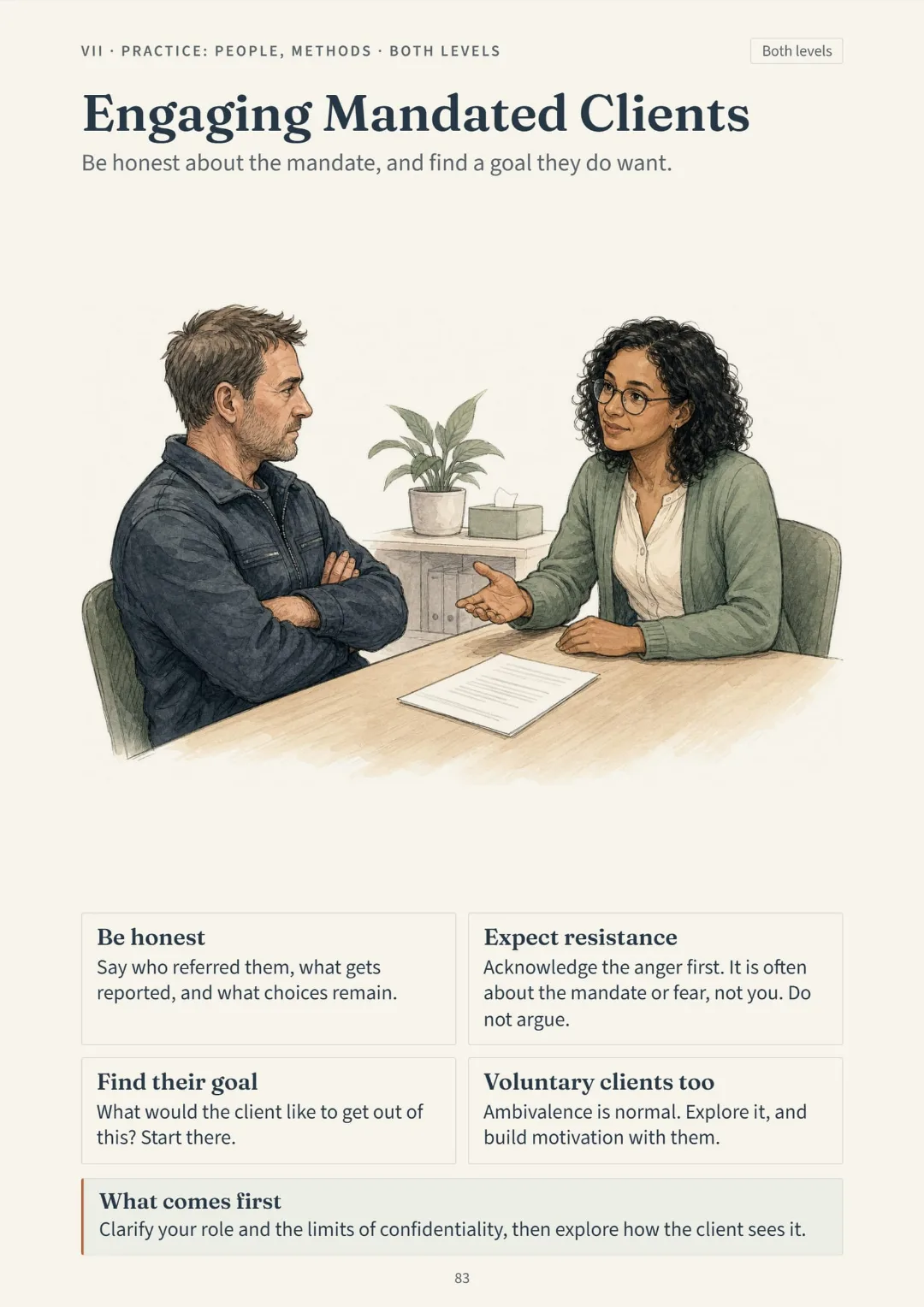
Be honest about the mandate, and find a goal they do want. Be clear about the mandate, then look for what the client wants.
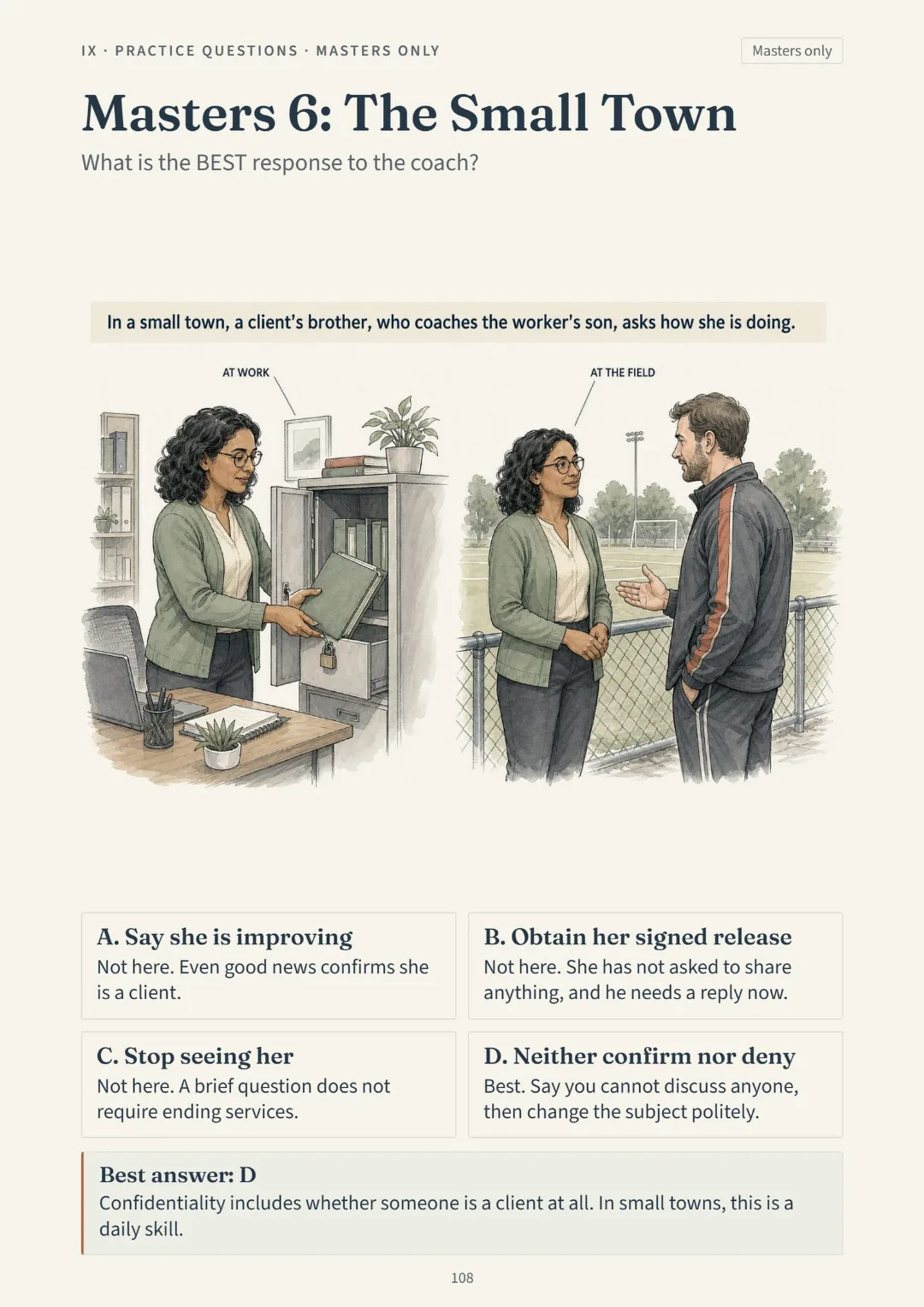
In a small town, a client's brother, who coaches the worker's son, asks how she is doing. Best answer: D.
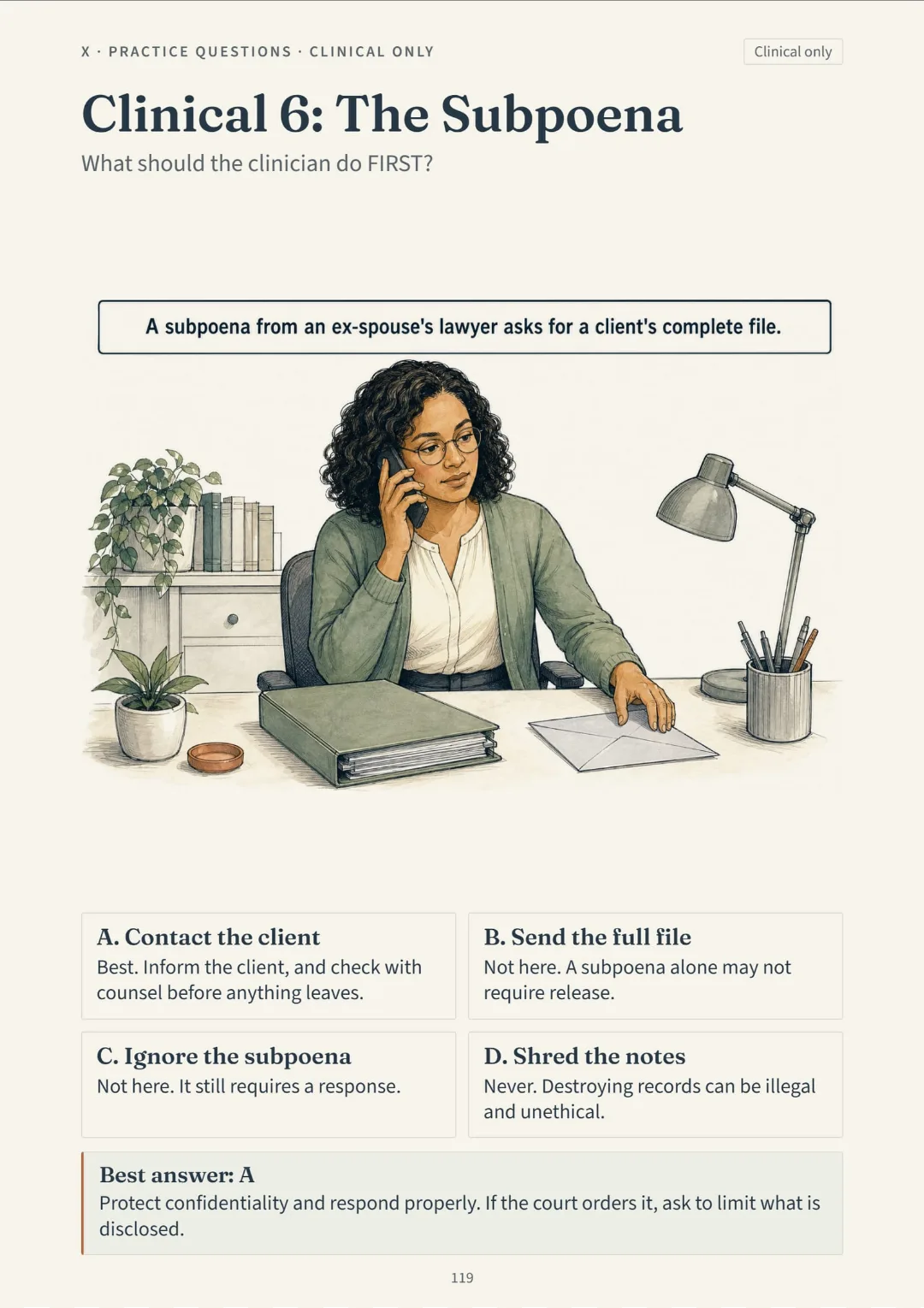
A subpoena from an ex-spouse's lawyer asks for a client's complete file. Best answer: A.

Swipe to see more · tap to zoom →

It’s not just recall. It’s choosing what comes first.

You know the theory. But when the question asks FIRST, every option can look right, and two good ones can leave you stuck.

You review the rationale after dinner. It tells you why that letter wins, but not how to get there yourself on the next question.

Your notes cover the terms. It’s harder to see how to work through the decision.

A way to reason, not an official ASWB rule. When several options look right, ask: safety, assess, then intervene.

This page gives you three questions to ask: Is anyone at risk right now? Do you know enough? Only then, what do you do? Use them on the facts before you choose.

This is a study aid, not an official ASWB rule or a fixed answer formula. The question still decides what comes first.

Give each choice a reason, not just a letter.

COMPARE

The same topic, studied two ways

INSTEAD OF THIS
  • Read a long paragraph about access.
  • Memorize language, disability, and culture as separate terms.
  • Miss how communication affects assessment.
Assessment accessibility requires the practitioner to consider linguistic, disability-related, and cultural factors that may affect the reliability of information elicited during the helping process, rather than treating communication as a secondary administrative concern. Before proceeding with substantive assessment, the practitioner should establish an appropriate means of communication, identify relevant access barriers, and consider whether the available arrangements support meaningful participation without substituting assumptions for the client's own account.
CHOOSE THIS
  • See the access issue in one drawn scene.
  • Connect communication with assessment.
  • Ask what must be in place before assessment begins.
Without communication, there is no assessment. Arrange real communication before you try to assess anyone.
CONTENTS

All 10 parts, page by page

Start with the order of decision, then work through ethics, assessment, planning, and practice. Finish with separate Masters and Clinical question sets. This is a review companion, not a complete prep course.

IStart Here: The Order of Decision · pp. 7-14
  1. How to Use This Book
  2. The Exam Today
  3. The Three Areas and Their Weights
  4. Reading FIRST, NEXT, BEST and MOST
  5. The Order of Decision
  6. When Safety Wins
  7. When Assessing Wins
  8. When Intervening Wins
IIDuties, Consent and Privacy (Area I: Values and Ethics) · pp. 15-22
  1. Core Values and Who You Owe
  2. Working Through an Ethical Dilemma
  3. Informed Consent
  4. Confidentiality and Its Limits
  5. HIPAA, PHI and Psychotherapy Notes
  6. Substance Use Records: A Stricter Rule
  7. Burnout, Secondary Trauma, Compassion Fatigue
  8. Self-Care and Staying Current
IIILimits, Reports and Records (Area I: Values and Ethics) · pp. 23-35
  1. Boundaries and Dual Relationships
  2. Self-Determination and Its Limits
  3. Mandatory Reporting: Suspicion Is Enough
  4. Duty to Warn and Protect
  5. An Impaired Colleague: What Comes First
  6. Records and Billing
  7. Self-Disclosure, Gifts and Conflicts of Interest
  8. Policy Shapes Practice
  9. Death and Dying: Law and Ethics
  10. Ethics for Supervisors and Managers
  11. Electronic Practice
  12. Ending Services Ethically
  13. Research Ethics (Clinical only)
IVEquity and Justice (Area I: Values and Ethics) · pp. 36-41
  1. Anti-Oppressive Practice and Justice
  2. Identity and Intersectionality
  3. Bias, Privilege and Power
  4. Access: Language, Disability, Culture
  5. Exploitation and Immigration
  6. Truth, Reconciliation and Restoration
VPeople, Harm and Illness (Area II: Assessment and Planning) · pp. 42-61
  1. Biopsychosocial Assessment
  2. Development: Stages Side by Side
  3. Typical or Atypical?
  4. Identity and Body Image
  5. Poverty, Place and Climate
  6. Family and Relationship Dynamics
  7. Aging, Ability and Caregiving
  8. Placement and Displacement
  9. Technology and Social Media
  10. Capacity, Emancipation, Age of Consent
  11. Defense Mechanisms
  12. Trauma, Stress and Crisis
  13. Abuse and Neglect: The Indicators
  14. Who Harms: Exploitation Across Life
  15. Substance Use and Co-Occurring Conditions
  16. Signs of Mental Illness Across Life
  17. Using the DSM in Assessment (Clinical only)
  18. Mood, Anxiety and Trauma Groups (Clinical only)
  19. Psychotic and Personality Groups (Clinical only)
  20. Brain-Related Conditions (Clinical only)
VIHow to Assess and Plan (Area II: Assessment and Planning) · pp. 62-72
  1. Interviewing
  2. Assessing Risk of Harm
  3. Strengths, Resources, Resilience
  4. Asking Sensitive Questions
  5. Readiness for Change
  6. Goals, Triage, Choosing a Method
  7. Communication and Outside Records
  8. The Mental Status Exam
  9. Resources and Culture in the Plan
  10. Medications: What You Watch For
  11. Ready to End Services?
VIIPeople and Methods (Area III: Intervention and Practice) · pp. 73-93
  1. Strengths and the Helping Relationship
  2. Problem-Solving and Teamwork
  3. End of Life, Loss and Grief
  4. Permanency Planning (Masters only)
  5. Organizing and Social Change (Masters only)
  6. Psychoeducation and Parenting Skills
  7. Listening and Communication
  8. Setting Limits, Resolving Conflict
  9. Trauma-Informed Care
  10. Crisis Intervention
  11. Engaging Clients Who Didn't Choose This
  12. Regulation, Coping, Stress, Anger
  13. Advocacy and Service Networks
  14. Case Management, Contracts, Discharge
  15. CBT and DBT Side by Side
  16. MI, Mindfulness and EMDR
  17. Harm Reduction and Addiction Care
  18. Group Work
  19. Family Therapy Models
  20. Assertiveness, Role Play, Modeling (Clinical only)
  21. Couples Interventions (Clinical only)
VIIIEvaluate, Supervise, Lead (Area III: Intervention and Practice) · pp. 94-102
  1. Measuring Client Progress
  2. Evaluating Your Own Practice (Masters only)
  3. Evaluating Agency Programs
  4. Programs: Objectives, Documents, Quality (Clinical only)
  5. Research Design and Validity
  6. Organizations and Budgets (Clinical only)
  7. Supervision: Roles and Transference
  8. Policies That Reduce Risk
  9. A Safe, Inclusive Workplace (Masters only)
IXPractice Questions: Masters · pp. 103-113
  1. Masters 1: The New Client
  2. Masters 2: The Sleepy Student
  3. Masters 3: The Refusal
  4. Masters 4: What the Child Says
  5. Masters 5: The Hard Sentence
  6. Masters 6: The Small Town
  7. Masters 7: The Healer
  8. Masters 8: The Sudden Change
  9. Masters 9: One Loud Voice
  10. Masters 10: Friday Discharge
  11. Masters 11: The Bus Route
XPractice Questions: Clinical · pp. 114-124
  1. Clinical 1: The Move
  2. Clinical 2: The Missing History
  3. Clinical 3: The Ex-Partner
  4. Clinical 4: The Right Method
  5. Clinical 5: After the Crash
  6. Clinical 6: The Subpoena
  7. Clinical 7: Messages From the TV
  8. Clinical 8: The Offer
  9. Clinical 9: The Slow Change
  10. Clinical 10: What She Says Alone
  11. Clinical 11: The Goodbye

One topic. One page. One drawing.

Keep the scene and the decision together. Each page is marked Both levels, Masters only, or Clinical only, so you can follow the topics for your exam.

Be honest about the mandate, and find a goal they do want. Be clear about the mandate, then look for what the client wants.

This page shows engagement with a mandated client: be clear about the mandate, then look for a goal the client wants.

You can see both parts of the task on one page: explain the requirement and make room for the client’s own goal.

Use the drawing to recall the reason behind the step.

What's inside What Comes First

Ipp. 7-14

Start Here: The Order of Decision

Learn how to read FIRST, NEXT, BEST, and MOST, then use the order of decision with the facts in each question.

IIpp. 15-22

Duties, Consent and Privacy (Area I: Values and Ethics)

Review core values, informed consent, privacy, and the limits of confidentiality.

IIIpp. 23-35

Limits, Reports and Records (Area I: Values and Ethics)

Work through boundaries, reporting duties, records, electronic practice, and ending services.

IVpp. 36-41

Equity and Justice (Area I: Values and Ethics)

Connect equity and justice with identity, power, language, disability, and access.

Vpp. 42-61

People, Harm and Illness (Area II: Assessment and Planning)

Review development, family life, social conditions, and assessment topics, with Clinical-only sections clearly marked.

VIpp. 62-72

How to Assess and Plan (Area II: Assessment and Planning)

Follow interviewing, strengths, readiness, goals, and planning from the information gathered.

VIIpp. 73-93

People and Methods (Area III: Intervention and Practice)

Compare ways to engage clients, communicate, coordinate services, and choose methods.

VIIIpp. 94-102

Evaluate, Supervise, Lead (Area III: Intervention and Practice)

Review progress measures, program evaluation, research, supervision, and agency policies.

IXpp. 103-113

Practice Questions: Masters

Practice with 11 original Masters questions and explanations for every answer option.

Xpp. 114-124

Practice Questions: Clinical

Practice with 11 original Clinical questions and explanations for every answer option.

Plus, 2 free books come with it

The Extra Rounds: More Practice by Level

GIFT 1: «The Extra Rounds: More Practice by Level»

Value: US$ 22.90

Keep practicing with more original questions: one set per exam area at each level, plus mixed FIRST and NEXT sets, with the reasoning behind every option right underneath.

First or Next: Decision Sheets

GIFT 2: «First or Next: Decision Sheets»

Value: US$ 18.90

Print one-page drawn sheets for your desk, from reading FIRST, NEXT, BEST and MOST to reporting limits and ending services.

Your bundle: What Comes First and 2 gifts

  • What Comes First: 118 illustrated pagesUS$ 74.90
  • GIFT 1: The Extra Rounds: More Practice by LevelUS$ 22.90
  • GIFT 2: First or Next: Decision SheetsUS$ 18.90
  • High-quality PDF file, ready to printIncluded
Total value US$ 116.70
BUNDLE PRICE
US$ 29.90
YOU SAVE: US$ 86.80
GET WHAT COMES FIRST · US$ 29.90

Digital PDF book, sent by email. Nothing ships in the mail.

Protected paymentEncrypted data30-day guarantee

PDF by email: You receive What Comes First as a PDF in your inbox, along with the 2 free books. You pay once: no installments, no extra charges.

Does this fit the way you need to study?

You're preparing for the Masters exam

You're preparing for the Masters exam

Often the LMSW; the title varies by state. Follow the shared and Masters-only pages, then work through the Masters practice set.

You're preparing for the Clinical exam

You're preparing for the Clinical exam

Often the LCSW; the title varies by state. Use the shared and Clinical-only pages to review the reasoning, then practice with the Clinical set.

You already have questions to practice

You already have questions to practice

Use the drawn pages alongside your course or app, or after a first try at the exam, when you want to examine why one choice comes before another.

Everything your purchase includes

US$ 116.70US$ 29.90
GET WHAT COMES FIRST · US$ 29.90

Digital PDF book, sent by email. Nothing ships in the mail.

30DAYS
GUARANTEE

30 days to try it

You have a 30-day, 100% money-back guarantee. Try the guide in your study sessions. If it doesn't help you compare answer choices, email us at hello@fenix-books.com with what didn't work and we'll refund 100%.

Common questions

Is this a printed book or a digital book?

It’s a digital PDF book by email. The two included books are PDFs too. You can print them.

Can I read it on my phone?

Yes. It's a PDF, so you can zoom in on any page on your phone. You can also use a tablet or computer, or print it.

Can I use it if I’m just starting exam prep?

Yes. Start with the opening pages and follow the tags for your level. Use it alongside whatever prep you choose.

How do I receive the material?

The book and both bonus books are sent as PDFs to the email address you enter at checkout.

Is this a one-time payment?

Yes. This book package is a one-time purchase, not a subscription.

Where does the content come from?

From the current ASWB guidebook and content outlines, the NASW Code of Ethics, federal rules such as HIPAA and the ADA, and professional guidance, all explained in our own words. Where rules vary by state, the book tells you to check with your board.

Is this an official exam guide?

No. Independent study guide. Not affiliated with or endorsed by ASWB, APA or NASW. Every practice question is original: none comes from an official exam, another question bank, or a candidate's memory.

Does it replace training, supervision, or professional advice?

No. It is study material. It does not replace education, supervised practice, clinical judgment, or consultation with a qualified professional.

Does it cover Masters and Clinical?

Yes. Pages are tagged by level, and each level has its own practice set with 11 original questions and full explanations. The scope follows the August 2026 ASWB content outlines; check ASWB for current exam information. It is not a complete exam-prep course.

Will this tell me which license I need in my state?

No. Your state board sets license requirements and exam eligibility. Confirm your required exam level and current state rules with your board. This purchase does not award a license, certificate, or continuing education credit.

Will the decision order always give me the right answer?

No. It is a reasoning aid, not an official scoring rule. Read each case in full. The guide adds drawn explanations to your practice; it does not guarantee a passing score.

Before you close this page

You already know the theory. Give your study time one clear task: explain why this choice comes first.

Keep the scene, the choice, and the reason together as you practice.

When two answers look right, give yourself a way to compare them. Start with a page you can see and a reason you can explain.

US$ 29.90, paid once · 30-day guarantee · PDF by email

GET WHAT COMES FIRST · US$ 29.90

Digital PDF book, sent by email. Nothing ships in the mail.